

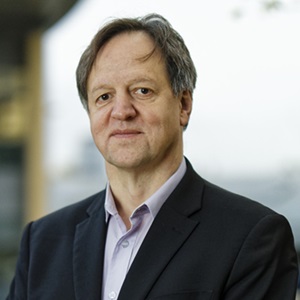
Professor HARALD HAAS FREng FRSE FIEEE FIET is the Director of the LiFi Research and Development Centre (LRDC) at the University of Cambridge. He is also the initiator, co-founder, and Chief Scientific Officer of pureLiFi Ltd. He received his PhD degree from the University of Edinburgh in 2001. He has authored 650 conference and journal papers, including papers in Science and Nature Communications. Haas’ main research interests are in optical wireless communications (OWC), hybrid optical wireless and radio frequency communications, spatial modulation, and interference coordination in wireless networks. His team invented spatial modulation. He introduced LiFi to the public at an invited TED Global talk in 2011. This talk on Wireless Data from Every Light Bulb has been watched online over 2.79 million times. LiFi was listed among the 50 best inventions in TIME Magazine in 2011. He gave a second TED Global lecture in 2015 on the use of solar cells as LiFi data detectors and energy harvesters. This has been viewed online over 2.90 million times. In 2016, he received the Outstanding Achievement Award from the International Solid State Lighting Alliance. In 2019 he was recipient of the IEEE Vehicular Society James Evans Avant Garde Award. Haas was elected a Fellow of the Royal Society of Edinburgh (RSE) in 2017. In the same year he received a Royal Society Wolfson Research Merit Award and was elevated to IEEE Fellow. In 2018 he received a three-year EPSRC Established Career Fellowship extension and was elected Fellow of the IET. Haas was elected Fellow of the Royal Academy of Engineering (FREng) in 2019. He received the Alexander von Humboldt Research Award from the Alexander von Humboldt Foundation in Germany in 2022. In 2023, he was shortlisted for the European Patent Office Inventor Award in the category ‘Research’.